Alaska Condominium Fees and Mortgage Qualification
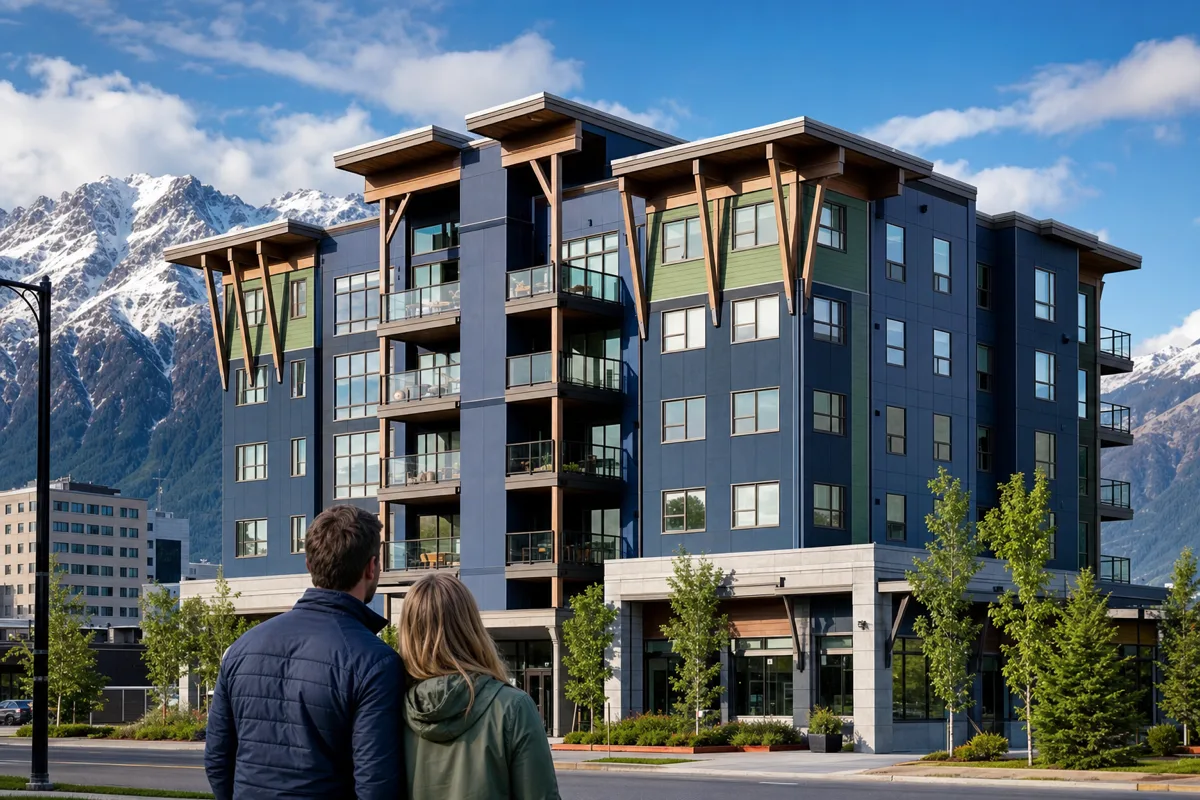
Condominiums offer a compelling homeownership option in Anchorage and Alaska’s larger cities — lower maintenance burden, often more central locations, and accessible price points in expensive markets. But alaska condominium fees mortgage qualification involves unique rules that many buyers don’t anticipate. HOA dues directly reduce your borrowing power, FHA and VA condo approval requirements add complexity, and Alaska’s condo market has specific characteristics worth understanding before you make an offer.
How HOA Dues Affect Your Debt-to-Income Ratio
When a lender calculates your debt-to-income (DTI) ratio for a condo purchase, the monthly HOA fee is included in your total housing payment. This directly reduces your qualifying loan amount.
Example:
- Your maximum DTI allows a $2,200 housing payment
- Property taxes: $300/month
- Homeowner’s insurance: $150/month
- HOA dues: $350/month
- Remaining for principal + interest: $1,400/month
- At 7% interest, $1,400/month supports approximately a $211,000 loan
Compare this to a single-family home with no HOA where that same buyer could carry approximately $1,750/month in P&I, supporting about a $263,000 loan. The $350/month HOA fee reduced purchasing power by over $50,000.
In Anchorage’s condo market, HOA dues range from as low as $150/month for smaller owner-managed associations to $600-1,000+/month for larger complexes with extensive amenities and staff. Always ask for the full HOA dues breakdown before falling in love with a condo, and run the DTI math early.
What HOA Dues Actually Cover in Alaska
Alaska condo associations manage costs that are particularly significant given the climate:
Building heat and utilities: Some Anchorage condo complexes include heat (fuel oil or natural gas) in HOA dues. This is a significant benefit given Alaska heating costs — but makes the HOA fee appear high when comparing to complexes where residents pay heat separately.
Snow removal and grounds: Alaska’s heavy snowfall requires extensive grounds maintenance. Well-managed associations budget appropriately; underfunded associations may let maintenance slip, which affects property values and appraised values.
Reserve fund contributions: Alaska building systems (boilers, roof systems, exterior siding) face accelerated wear from freeze-thaw cycles, UV exposure in summer, and moisture. Adequate reserve funding is critical. An underfunded reserve means a future special assessment — a lump-sum charge to all owners when major repairs are needed.
Elevator and parking: Many Anchorage condo buildings have heated underground parking, which is standard in extreme-cold climates. This adds to HOA costs but is genuinely valuable in winter.
Special Assessments: The Hidden Risk
A special assessment is an additional charge levied by a condo association beyond regular dues. These occur when:
- A major repair wasn’t adequately funded by reserves (roof replacement, boiler replacement, parking structure repair)
- Unexpected damage occurs (water intrusion, fire, structural issues)
- An HOA has been chronically underfunding reserves and needs to catch up
In Alaska, special assessments are not uncommon given the demands placed on building systems. Before purchasing any condo, request:
- The last 3 years of HOA financial statements
- The current reserve study (required for FHA/VA approval)
- Meeting minutes from the last 12 months (look for discussion of major repairs or financial stress)
- Disclosure of any pending or planned special assessments
A special assessment of $15,000-$30,000 is not unheard of in aging Anchorage condo complexes. This could come due shortly after your purchase, creating a financial stress you didn’t plan for.
FHA Condo Approval in Alaska
FHA financing for condominiums requires the entire condo project (not just your individual unit) to be on the FHA-approved condo list. Not all Alaska condo complexes are approved.
To check FHA approval: search the HUD condo approval database at HUD.gov using the project name or address. If a project isn’t approved, buyers either need conventional financing (which has different condo requirements) or the HOA can pursue FHA approval — a process that takes months and requires HOA cooperation.
Key FHA condo project requirements:
- At least 50% of units must be owner-occupied (rental units can’t dominate)
- No single entity can own more than 10% of units (no investor-owned bulk portfolio)
- HOA must have adequate insurance (fidelity/crime coverage above certain thresholds)
- Less than 15% of units can be delinquent on HOA dues
- Reserve fund must be at least 10% of annual budget
- No pending litigation involving the HOA that could affect the project’s financial health
Several Anchorage condo complexes have lost FHA approval due to high rental rates — often because units were converted to short-term rentals (Airbnb). Before assuming FHA financing is available, verify current approval status.
VA Condo Approval Requirements
VA has similar project approval requirements for condo financing. The VA Condominiums Approval database (search at benefits.va.gov) shows VA-approved projects in Alaska.
VA added an important program feature: for projects not on the approved list, VA now allows “spot approval” in some circumstances. This is a case-by-case review of a single unit within an unapproved project. The process is more complex and not available in all cases, but it expands options for veteran buyers.
Conventional Condo Financing (Fannie Mae and Freddie Mac)
Conventional condo financing through Fannie Mae and Freddie Mac has different — and in some ways more flexible — requirements than FHA/VA. However, Fannie Mae’s condo review process has become more stringent in recent years following high-profile structural failures in other states.
Key conventional condo considerations:
- Warrantability review: Fannie/Freddie have lists of “non-warrantable” condo types that they won’t finance (high investor concentration, condo-hotel arrangements, certain new construction phasing situations)
- Condo questionnaire: the HOA must complete a lender questionnaire covering insurance, reserves, litigation, and ownership concentration
- Some Alaska condo complexes that were previously conventionally financeable have become non-warrantable as investor concentration increased
For non-warrantable condos, portfolio lenders — lenders who hold loans on their own balance sheets — may be the only option. Rates for non-warrantable condo loans are typically higher. Premier Mortgage (NMLS# 1168048) can assess whether a specific condo project you’re interested in is warrantable.
The Anchorage Condo Market
Anchorage has the largest condo inventory in Alaska, concentrated in the Midtown, Downtown, Turnagain, and South Anchorage areas. Price ranges are broad:
- Entry-level studio/1-BR units in older complexes: $150,000–$220,000
- 2-BR units in mid-range complexes: $220,000–$380,000
- Premium units with views or luxury amenities: $350,000–$600,000+
HOA dues in Anchorage condos have risen in recent years as buildings age and maintenance costs increase. When comparing two units with similar list prices, always factor in HOA dues to calculate total monthly cost. A $250,000 unit with $500/month HOA may have a higher total monthly housing cost than a $280,000 unit with $200/month HOA.
For related financing insights, see our guide on Alaska condo financing and our Anchorage home loan resources.
Frequently Asked Questions
Do all condos require FHA project approval in Alaska?
Only if you’re using FHA financing. Conventional loans have their own warrantability standards; VA has its own approval database. If a condo isn’t FHA-approved, your options are: conventional financing (if the project is warrantable), VA spot approval (if you’re a veteran), or waiting for the HOA to pursue FHA approval.
Can I deduct HOA dues on my taxes?
HOA dues on your primary residence generally are not tax-deductible. However, if you rent out your condo unit, HOA dues may be deductible as rental expenses. Alaska has no state income tax, so the federal deduction treatment is what applies. Consult a tax advisor for your specific situation.
What’s a reasonable HOA reserve fund percentage?
Industry standards suggest HOA reserves should be funded to at least 70-100% of the reserve study’s recommended amount. An HOA funded below 50% of recommended reserves is a risk flag. The reserve study should be updated every 3-5 years to account for changing replacement costs.
Can I negotiate who pays special assessments in an Alaska condo purchase?
In a purchase transaction, special assessments that have been levied but not fully paid as of closing are negotiable. You can ask the seller to pay any outstanding or pending assessments as a condition of sale. However, future assessments not yet levied are your responsibility as the new owner.
How does a condo loan differ from a single-family home loan in Alaska?
Beyond the HOA/project approval differences, condo loans may have slightly different rates. Loan-level price adjustments (LLPAs) for condos can add 0.375%–0.75% to your rate in some conventional scenarios, particularly with lower down payments. VA and FHA loans don’t typically have condo-specific surcharges beyond the standard program rates.
Considering condo financing in Anchorage or elsewhere in Alaska? Get Your Free Quote →
Premier Mortgage NMLS# 1168048. All loan programs subject to credit approval. Condo project approval status subject to change — verify with your lender before application. Rates and terms vary. This content is for educational purposes only.
Ready to Take the Next Step?
Get a free home loan quote today through our trusted partner.
Or call 9078411600
Disclaimer: This article is for informational purposes only and does not constitute financial, mortgage, legal, or tax advice. Interest rates, loan programs, eligibility requirements, and fees are subject to change without notice and may vary based on your individual circumstances. Alaska Home HQ is not a lender, broker, or financial institution. All loan applications are processed by Premier Mortgage (NMLS: 1168048). We may have a business relationship with Premier Mortgage and may receive compensation when you use their services through our links. Consult a licensed mortgage professional before making financial decisions. Terms of Service · Privacy Policy