Alaska FHA Loan Limits 2026: What Buyers Need to Know
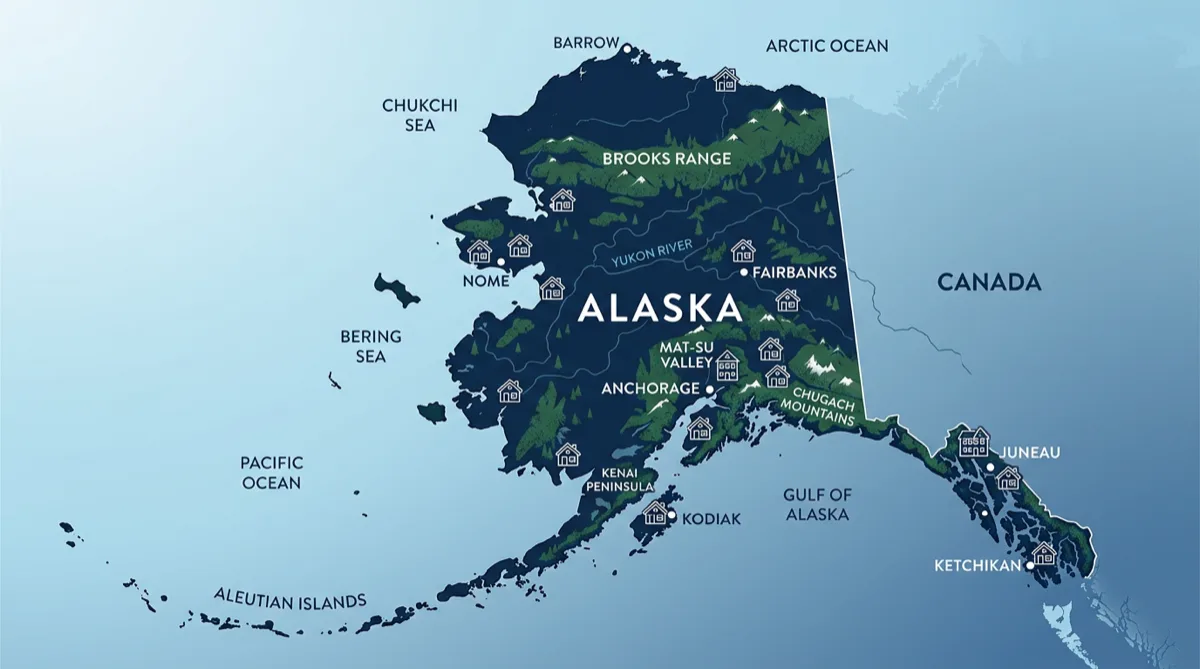
Alaska FHA loan limits in 2026 give buyers across the state significantly more purchasing power than the national baseline — and most Alaskans don’t realize just how generous these limits actually are.
If you’re considering an FHA loan to buy a home in Alaska, understanding the current limits is essential. The 2026 Alaska FHA loan limits affect how much you can borrow, which homes are within reach, and whether you need to consider alternative financing for higher-priced properties.
What Are Alaska FHA Loan Limits for 2026?
The Federal Housing Administration (FHA) sets loan limits annually based on median home prices in each county. Because Alaska is classified as a “high-cost area” by HUD, Alaska FHA loan limits are set at 150% of the national conforming loan limit baseline.
For 2026, the standard FHA loan limit in Alaska is $557,750 for a single-family home in most boroughs. This is more than double the national floor limit of $524,225, which applies to lower-cost areas across the contiguous United States.
Here’s how Alaska FHA limits break down by property type for most boroughs:
| Property Type | 2026 FHA Loan Limit (Alaska) |
|---|---|
| Single-family | $557,750 |
| Duplex (2-unit) | $714,000 |
| Triplex (3-unit) | $863,150 |
| Fourplex (4-unit) | $1,072,750 |
These limits apply across the majority of Alaska’s boroughs and census areas. Certain areas with even higher median prices — including parts of the Matanuska-Susitna Borough and Anchorage — may qualify for ceiling-level limits under FHA’s high-cost exception. Buyers in these areas should confirm the exact limit with their lender.
Why Alaska FHA Limits Are Higher Than the Lower 48
Alaska’s elevated FHA loan limits reflect the higher cost of housing across the state. A combination of factors drives up home prices in Alaska:
- Geographic isolation: Materials and labor cost more to transport to Alaska, raising construction costs
- Military and government demand: JBER, Eielson Air Force Base, Clear Space Force Station, and other installations bring a consistent influx of buyers
- Limited inventory: Many Alaska communities have constrained housing supply relative to demand
- Remote and rural premiums: Properties outside major corridors carry access and infrastructure costs that raise values
HUD reviews these limits annually based on the Federal Housing Finance Agency’s (FHFA) House Price Index. Because Alaska home values have remained elevated relative to the national average, the state’s high-cost designation has held.
How FHA Loans Work in Alaska
FHA loans are government-backed mortgages administered by the Federal Housing Administration under HUD. They’re popular with Alaska buyers because they offer:
- Lower down payment: As little as 3.5% down for borrowers with a credit score of 580 or higher
- Flexible underwriting: More forgiving debt-to-income ratios compared to conventional loans
- Competitive rates: Often comparable to or slightly below conventional loan rates
- Seller concessions: Sellers may contribute up to 6% of the purchase price toward closing costs
On a $557,750 FHA loan at the maximum limit, the minimum down payment would be approximately $19,521 — significantly more achievable than the 20% down ($111,550) required to avoid PMI on a conventional loan.
Ready to explore FHA financing? Get a free home loan quote from Premier Mortgage (NMLS# 1168048).
Alaska FHA Loan Limits by Borough
While most of Alaska falls under the standard high-cost limit, it’s worth knowing that HUD calculates limits borough-by-borough. If you’re buying in a specific area, your lender can confirm the exact limit. The most commonly asked-about areas:
Anchorage Municipality: $557,750 (single-family). Anchorage is the state’s most active housing market — see best neighborhoods in Anchorage for neighborhood comparisons.
Matanuska-Susitna Borough (Wasilla/Palmer): $557,750 (single-family). The Mat-Su Valley is one of the fastest-growing housing markets in Alaska. Learn more about buying a house in Alaska for a broader overview.
Fairbanks North Star Borough: $557,750 (single-family). Home to Eielson Air Force Base and University of Alaska Fairbanks — a diverse buyer pool including military families.
Kenai Peninsula Borough: $557,750 (single-family). Including Soldotna, Kenai, and Homer — popular retirement and recreational markets.
Southeast Alaska (Juneau, Sitka, Ketchikan): $557,750 (single-family). Limited road access creates unique market dynamics.
FHA vs. Conventional: Which Makes Sense at These Limits?
At Alaska’s $557,750 FHA limit, buyers have meaningful options. Here’s when FHA typically wins — and when conventional may be better:
FHA makes sense when:
- You have 3.5%–10% for a down payment
- Your credit score is in the 580–679 range
- You want more flexible debt-to-income qualification
- You’re a first-time buyer using Alaska’s down payment assistance programs
Conventional may be better when:
- Your credit score is 740+ (better rates on conventional)
- You can put 20% or more down (avoiding mortgage insurance entirely)
- The purchase price exceeds $557,750 (FHA’s limit — you’d need a jumbo loan otherwise)
- You’re purchasing an investment property or second home (FHA is primary residence only)
FHA loans require an upfront mortgage insurance premium (MIP) of 1.75% of the loan amount, plus an annual MIP of approximately 0.55% — these costs should factor into your comparison.
What Happens If the Home Price Exceeds the FHA Limit?
If the home you want to purchase costs more than the FHA limit in your area, FHA financing won’t work for that property. Your options include:
- Conventional loan — Higher limits, but typically requires stronger credit and larger down payment
- VA loan — If you’re an eligible veteran, VA loans have no loan limit for first-time use of full entitlement (and Alaska has a strong military presence with JBER and Eielson)
- Jumbo loan — Exceeds conforming limits; typically requires 10–20% down and strong financials
- AHFC programs — Alaska Housing Finance Corporation offers state-specific loan programs with their own eligibility criteria
Read our guide to FHA loans in Alaska for a comprehensive overview of FHA eligibility requirements.
Tips for Alaska FHA Buyers in 2026
-
Get pre-approved before shopping: Knowing your exact FHA limit and qualification amount before viewing homes saves significant time and heartache.
-
Check borough-specific limits: Especially if buying in a remote area — your lender can confirm the exact ceiling.
-
Factor in MIP costs: Upfront and annual mortgage insurance premiums add to the cost of FHA financing. Run the numbers against conventional options.
-
PFD timing: Alaska’s Permanent Fund Dividend can be a valuable supplement for down payments and closing costs — see our guide on using your PFD for a down payment.
-
Look at AHFC layering: Some buyers stack FHA with AHFC programs for additional rate benefits — ask your lender about compatibility.
-
Explore Eagle River and Mat-Su: If Anchorage proper is too pricey, Eagle River and the Mat-Su Valley offer more affordable entry points while staying within FHA limits.
Frequently Asked Questions
What is the FHA loan limit in Alaska for 2026?
The standard FHA loan limit for a single-family home in most Alaska boroughs is $557,750 for 2026. This is based on Alaska’s classification as a high-cost area by HUD — set at 150% of the national baseline limit. Multi-unit properties have higher limits, up to $1,072,750 for a fourplex.
Can I use an FHA loan to buy a home in rural Alaska?
Yes, FHA loans can be used for properties in rural Alaska, subject to FHA’s property condition requirements (the home must be safe, sound, and secure). However, if you’re purchasing in a USDA-eligible rural area, a USDA loan may offer a zero-down alternative worth exploring alongside FHA.
How much down payment do I need for an Alaska FHA loan?
With a credit score of 580 or higher, FHA requires a minimum 3.5% down payment. On a $557,750 home (the 2026 limit), that’s approximately $19,521. Buyers with scores between 500–579 would need 10% down under FHA guidelines, though most Alaska lenders require 580+ as a practical minimum.
Do Alaska FHA limits apply to new construction?
Yes, Alaska FHA loan limits apply to both existing homes and new construction. For new construction, the property must meet FHA appraisal and inspection requirements, and the builder must be FHA-approved. Construction-to-permanent loans follow slightly different guidelines.
Are FHA loan limits the same in every Alaska borough?
Most Alaska boroughs use the standard high-cost limit of $557,750 for single-family homes. However, HUD reviews limits annually by county/borough — it’s always worth confirming the current limit for your specific area with your lender before making an offer.
Ready to Take the Next Step?
Get a free home loan quote today through our trusted partner.
Or call 9078411600
Disclaimer: This article is for informational purposes only and does not constitute financial, mortgage, legal, or tax advice. Interest rates, loan programs, eligibility requirements, and fees are subject to change without notice and may vary based on your individual circumstances. Alaska Home HQ is not a lender, broker, or financial institution. All loan applications are processed by Premier Mortgage (NMLS: 1168048). We may have a business relationship with Premier Mortgage and may receive compensation when you use their services through our links. Consult a licensed mortgage professional before making financial decisions. Terms of Service · Privacy Policy