Alaska Mortgage Calculator: Factor In Your PFD
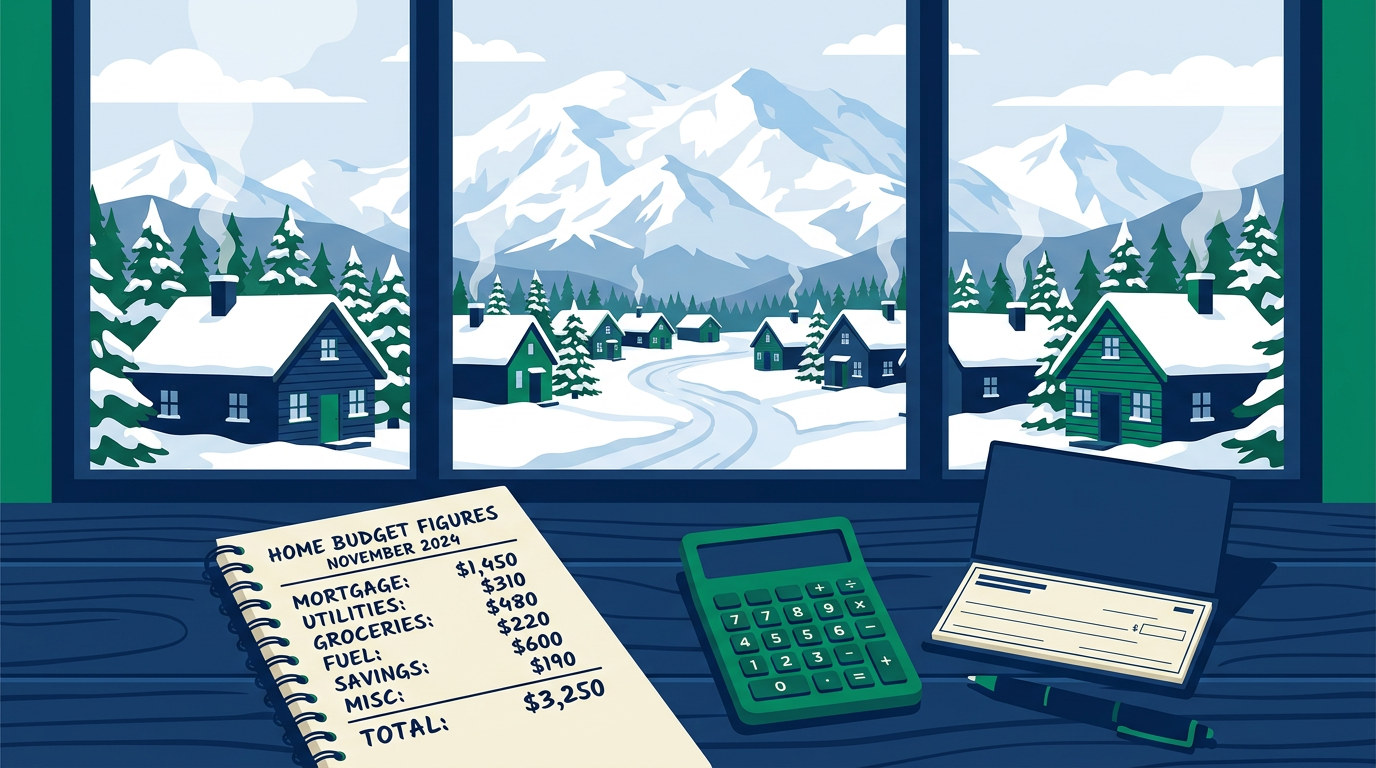
Standard mortgage calculators are built for the Lower 48. They calculate principal and interest, plug in PMI and insurance, and output a monthly payment. What they almost never account for is Alaska’s PFD income boost, the state’s dramatically higher heating costs, and property tax structures that vary wildly by borough.
If you are buying a home in Alaska, you need a more complete budget model. Here is how to build one that reflects the full picture of Alaska homeownership costs — and how to use the Permanent Fund Dividend strategically.
Start With the Standard Calculation
The baseline mortgage payment for principal and interest follows the same formula everywhere:
For a $400,000 loan at a 30-year term, here is how monthly payments shift with interest rate:
| Rate | Monthly P&I | Total Interest (30 yr) |
|---|---|---|
| 6.0% | $2,398 | $463,353 |
| 6.5% | $2,528 | $510,177 |
| 7.0% | $2,661 | $558,036 |
| 7.5% | $2,797 | $606,841 |
This is the foundation. In Alaska, four additional factors significantly change the real monthly cost of homeownership.
Factor 1: Alaska Heating Costs
Alaska homes require substantially more energy to heat than equivalent homes in the Lower 48. The Alaska Energy Authority estimates average annual household energy costs of $2,500–$5,500 per year, with some areas running higher. That translates to monthly heating costs averaging:
- Anchorage (natural gas):
$150–$250/month in winter, lower in summer - Mat-Su Valley (fuel oil):
$200–$350/month winter average - Fairbanks (fuel oil + wood):
$250–$500/month in the coldest months - Rural areas (fuel oil by barge): Heating fuel can cost
$5–$8per gallon in off-road communities, making monthly heating bills$400–$800+ for a typical home
For a realistic monthly housing budget, add your estimated heating cost directly to the mortgage payment calculation. Many homebuyers dramatically underestimate this line item.
VA lenders specifically account for heating costs in their residual income calculation — a measure of monthly disposable income after housing expenses. If your heating costs are high and residual income falls below VA’s minimum threshold, you may not qualify even if your debt-to-income ratio looks fine.
Factor 2: Property Taxes by Borough
Alaska has no statewide property tax, but most boroughs and municipalities levy their own. Rates vary significantly:
| Area | Approximate Property Tax Rate |
|---|---|
| Anchorage (MOA) | 11.78 mills (~1.18%) |
| Matanuska-Susitna Borough | 7.78 mills (~0.78%) |
| Fairbanks North Star Borough | ~14 mills (~1.4%) |
| Kenai Peninsula Borough | ~7–9 mills (~0.7–0.9%) |
| Juneau (CBJ) | ~10 mills (~1.0%) |
| Many smaller boroughs/unincorporated | 0 mills (no local property tax) |
On a $450,000 home in Anchorage, annual property taxes would be approximately $5,300 — or about $440 per month. In the Matanuska-Susitna Borough at 7.78 mills, the same assessed value generates approximately $3,500 per year — roughly $290 per month. The difference matters when comparing Anchorage vs. Valley purchasing scenarios.
Some Alaska boroughs offer senior citizen and disabled veteran property tax exemptions that can substantially reduce this line item. For a detailed breakdown, see our guide to Alaska property taxes by borough.
Factor 3: The Permanent Fund Dividend as a Savings Boost
The Alaska Permanent Fund Dividend is a unique income source that every Alaska resident who qualifies receives annually. Recent PFD amounts have ranged from approximately $900 to over $2,000 per resident (amounts vary annually based on fund performance and legislative action). For a family of four, PFD distributions can total $3,600–$8,000+ per year.
For mortgage purposes, the PFD has two key applications:
Down payment savings. A two-year history of receiving PFD — documented through your prior two state PFD applications — is acceptable documentation for down payment gift or savings sources for most loan programs. Lenders verify the PFD history via your state records. Even at conservative PFD levels, a family of four saving two years of PFD payments could accumulate $7,000–$16,000 specifically for a down payment.
Ongoing cash flow buffer. Many Alaska homeowners time major maintenance expenses — heating system service, roof work, winterization — to coincide with PFD distribution in October. Treating the annual PFD as a home maintenance reserve fund rather than discretionary income prevents the common trap of deferred maintenance that erodes Alaska home values.
Note that the PFD itself is not used as income for mortgage qualification — it is not a stable, recurring income stream in the way wages or Social Security payments are. Lenders look at earned income, rental income, and other documented recurring sources for qualification purposes.
For a detailed look at using your PFD in the home purchase process, see our guide to using the Alaska PFD for a down payment.
Factor 4: Insurance and PMI
Homeowners insurance in Alaska runs higher than the national average due to weather risks — wind, freeze damage, and the specific risks of each region (earthquake in Southcentral, flooding in Southeast). Budget $1,500–$3,000 per year for a standard homeowners policy in most Alaska markets, or roughly $125–$250 per month. Remote properties and those with non-standard features cost more.
If your down payment is below 20%, you will also pay private mortgage insurance (PMI) on a conventional loan (typically $50–$200/month depending on your loan amount and LTV) or FHA mortgage insurance premium (0.55% annually for most FHA loans). FHA MIP on loans originated after June 2013 is required for the life of the loan unless you refinance into a conventional product once equity reaches 20%.
Building Your Complete Alaska Housing Budget
Here is a sample monthly budget breakdown for a $450,000 purchase in the Mat-Su Valley with $22,500 down (5%), $427,500 loan, 30-year fixed at 7.0%:
| Cost Component | Monthly Amount |
|---|---|
| Principal & Interest | $2,845 |
| Property Tax (Mat-Su, 7.78 mills) | $292 |
| Homeowners Insurance | $167 |
| PMI (0.80% on $427,500) | $285 |
| Estimated Heating (fuel oil, Mat-Su avg) | $250 |
| Total Monthly Housing Cost | $3,839 |
Compare this to the “sticker” P&I payment of $2,845 — the actual monthly cost is 35% higher once Alaska-specific factors are included.
That same buyer who sets aside their family’s PFD ($1,800–$4,000 per year) as an annual housing buffer covers roughly one to three months of the heating cost differential in a single payment.
Getting Pre-Approved With Alaska’s Full Cost Picture
When you talk to a lender about pre-approval, make sure they understand your heating cost situation, your borough’s property tax rate, and your full insurance picture. A lender experienced in Alaska housing markets will factor these into their assessment of what payment is sustainable for you.
Premier Mortgage (NMLS# 1168048) works with Alaska buyers statewide and understands the full picture of Alaska housing costs.
Frequently Asked Questions
Does the Alaska PFD count as income for mortgage qualification?
No, the Alaska PFD is not counted as qualifying income by most lenders because it is not a stable, recurring income stream with a guaranteed continuation. Lenders use earned wages, self-employment income, retirement income, rental income, and other documented recurring sources for qualification. However, PFD funds can be used toward your down payment and documented as savings history.
How much should I budget for heating costs when buying in Fairbanks?
Budget $250–$500 per month in winter months for heating costs in Fairbanks, which translates to roughly $150–$300 per month averaged over the full year. Exact costs depend heavily on your home’s insulation quality, square footage, heating system type, and the severity of the winter. Ask the current homeowner for the last two years of utility bills — this is the best predictor of what you will actually pay.
What property tax rate should I use for an Alaska mortgage budget?
Use the actual mill rate for the borough or municipality where you are buying. Anchorage is approximately 11.78 mills, Mat-Su is approximately 7.78 mills, and Fairbanks North Star Borough is approximately 14 mills. Many rural areas have no local property tax. Your lender’s escrow calculation will include the actual rate, but building it into your pre-shopping budget prevents surprises. For a full comparison, see our Alaska property taxes by borough guide.
How long do I need to live in Alaska to qualify for the PFD?
To receive the Alaska Permanent Fund Dividend, you must have been an Alaska resident for the entire prior calendar year, intend to remain an Alaska resident indefinitely, and not have been absent from the state for disqualifying reasons. There is no minimum residence period before you can own a home in Alaska — homeownership is independent of PFD eligibility. The PFD application is filed separately each year.
Can I buy a home in Alaska with a low income if I qualify for AHFC?
Possibly. AHFC’s First Home and First Home Limited programs offer below-market interest rates that reduce monthly payments, making homeownership more accessible for lower-income Alaska buyers. AHFC income limits vary by program and family size, and the rate savings can be significant. For a complete overview of AHFC programs and income limits, see our guide to AHFC loan programs explained.
Ready to Take the Next Step?
Get a free home loan quote today through our trusted partner.
Or call 9078411600
Disclaimer: This article is for informational purposes only and does not constitute financial, mortgage, legal, or tax advice. Interest rates, loan programs, eligibility requirements, and fees are subject to change without notice and may vary based on your individual circumstances. Alaska Home HQ is not a lender, broker, or financial institution. All loan applications are processed by Premier Mortgage (NMLS: 1168048). We may have a business relationship with Premier Mortgage and may receive compensation when you use their services through our links. Consult a licensed mortgage professional before making financial decisions. Terms of Service · Privacy Policy