Alaska New Construction Loan Process Explained
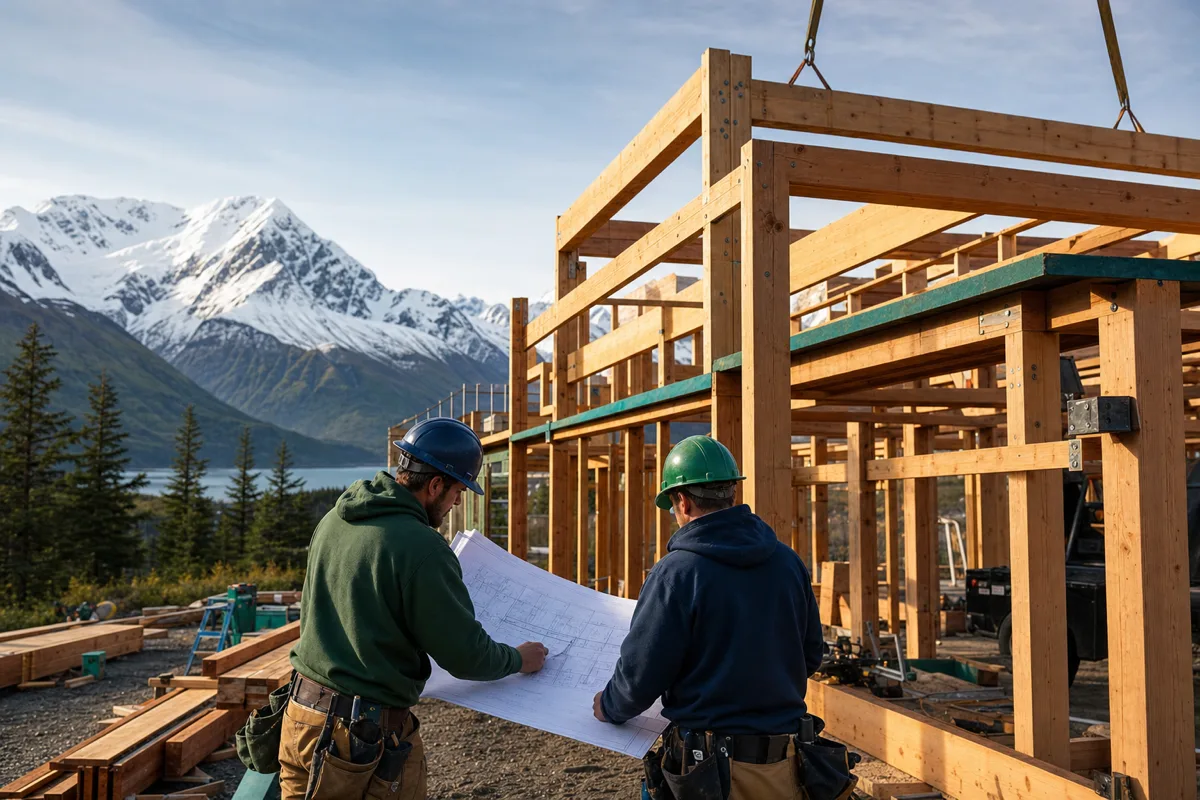
Building a new home in Alaska is a significant undertaking — and financing it is more complex than buying an existing property. The alaska new construction loan process involves multiple loan stages, disbursement schedules, and Alaska-specific challenges that don’t exist in most Lower 48 markets. This guide walks you through exactly what to expect from pre-approval to your certificate of occupancy.
Whether you’re building in Palmer’s agricultural belt, a new subdivision in Eagle River, or a custom cabin on land you’ve already purchased, understanding the construction loan structure before you break ground prevents costly surprises.
Two Main Construction Financing Structures
Construction-to-Permanent (C2P) Loan
This is the most common structure for Alaska new construction. A single loan covers both the construction phase and converts automatically to a permanent mortgage once the home is complete — one closing, one set of closing costs.
During construction, you draw funds as work progresses. Interest-only payments are made on the amount drawn. When construction is complete and the final inspection passes, the loan converts to your permanent mortgage with full principal and interest payments.
Advantages for Alaska buyers:
- One application, one credit pull, one closing
- Rate is locked (or set at conversion, depending on the lender)
- Simpler process for borrowers building their primary home
Construction-Only Loan + Permanent Mortgage
An alternative where you get a separate short-term construction loan (typically 6-12 months) and then refinance into a permanent mortgage at completion. This involves two closings and two sets of closing costs.
This structure sometimes makes sense when you expect to qualify for better permanent financing terms after income changes, or when you’re a contractor building spec homes. For most Alaska homebuilders, the C2P loan is more cost-effective.
Pre-Approval: What Alaska Lenders Evaluate
Construction loan underwriting is more rigorous than purchase loan underwriting because the lender is funding something that doesn’t exist yet. Alaska lenders will review:
Your financial profile:
- Credit score (typically 680+ for conventional construction loans; some programs allow lower)
- Debt-to-income ratio
- Reserves (construction surprises happen — lenders want to see 6+ months of payments in reserves)
- Income stability and documentation
The project itself:
- Builder qualifications and license (Alaska requires general contractor licensing for most residential construction)
- Detailed construction contract with fixed price or guaranteed maximum price
- Architectural plans and specifications
- Timeline and draw schedule
- Lot value and status (owned free-and-clear, or financed?)
Alaska-specific lender concerns:
- Short building season (May through September for most of the state)
- Permafrost considerations in Interior Alaska and some Mat-Su areas
- Septic and well permitting timelines (can take 2-4 months through ADF&G/DEC)
- Remote or hard-to-access sites that increase construction costs
The Draw Schedule: How Money Flows
Construction loans don’t disburse all at once. Funds are released in draws as work is completed and verified by an inspector or appraiser. A typical Alaska construction draw schedule looks like this:
Draw 1 — Foundation Complete (15-20%): Excavation, foundation pour or pile driving, stem wall or slab. In permafrost areas, this phase may include engineered pile systems.
Draw 2 — Framing Complete (20-25%): Structural framing, roof sheathing, windows and exterior doors rough-set. In Alaska, this milestone is critical before the rainy/snow season.
Draw 3 — Rough-ins Complete (15-20%): Electrical, plumbing, HVAC rough-ins, and insulation. Alaska’s energy code requirements for insulation are more stringent than national standards — confirm your plans meet current code.
Draw 4 — Interior Completion (20-25%): Drywall, interior trim, flooring, cabinet installation, paint.
Draw 5 — Final Completion (15-20%): Final inspections, certificate of occupancy, punch-list items. This triggers conversion to permanent mortgage.
Each draw request typically requires an inspection by a lender-approved inspector who confirms work is complete before funds are released. Build these inspection timelines into your schedule — inspectors in rural Alaska may have longer lead times.
The Contingency Requirement
Alaska construction lenders typically require a 5-10% contingency reserve built into the loan amount or held separately. This buffer covers cost overruns, which are common in Alaska for several reasons:
- Material shipping costs from the Lower 48 can spike with supply chain disruptions
- Labor shortages, particularly for specialty trades (electrical, plumbing, HVAC) in smaller markets
- Weather delays extending the construction timeline and increasing carrying costs
- Soil conditions discovered during excavation (permafrost, high water tables, organics)
Building without an adequate contingency in Alaska is a significant risk. Do not underfund this buffer to qualify for a lower loan amount.
AHFC New Construction Programs
Alaska Housing Finance Corporation supports new construction through several programs worth understanding before you apply:
AHFC Energy Efficiency Standards — new construction meeting AHFC’s Tier I or Tier II energy standards may qualify for interest rate reductions of 0.25% to 0.75% below standard AHFC rates. These standards require higher-than-code insulation, tight air sealing, and mechanical heat recovery. The upfront cost is typically recovered in energy savings and the rate discount over 3-5 years.
AHFC First Home Program — eligible for new construction for first-time buyers. Subject to income limits and purchase price caps that vary by community.
AHFC Direct Loans — in some rural communities where private lenders don’t operate, AHFC provides direct construction lending. Eligibility and terms vary significantly by location.
Premier Mortgage (NMLS# 1168048) is an approved AHFC lender and can help structure your financing to maximize available AHFC programs alongside your construction loan.
Alaska-Specific Construction Challenges
Builder licensing: Alaska requires general contractors to be licensed through the Division of Corporations, Business and Professional Licensing. Confirm your builder holds a current, active license before signing a construction contract. This is a lender requirement, not just good practice.
Permafrost: In Fairbanks and parts of the Interior, permafrost engineering changes your foundation design and cost. Pile-supported foundations are common. Lenders in these areas are familiar with this, but your appraiser must have comparable sales experience in permafrost areas.
Short building season: Most exterior work in Alaska happens between May and September. A construction loan that starts in October may not see significant progress until spring — understand how your lender handles interest-only payments during this period and whether draws can be made for pre-purchased materials.
Municipality permits: Anchorage, Mat-Su Borough, and Fairbanks North Star Borough have different permitting processes, timelines, and inspection requirements. Factor 2-6 weeks for permit approvals into your construction schedule.
For Palmer area buyers, see our Palmer Alaska real estate resources for borough-specific information. Eagle River new construction buyers can reference our Eagle River buyer guidance.
Converting to Permanent Financing
When construction is complete, your C2P loan converts to a permanent mortgage. Key steps:
- Final inspection and certificate of occupancy from local municipality
- Appraisal update confirming completed value matches or exceeds the “as-completed” appraisal done at origination
- Title update confirming no new liens during construction
- Final loan modification documents executed at conversion
If your completed home appraises below the projected value, you may need to bring cash to cover the shortfall at conversion — another reason to be conservative in your initial cost projections.
Frequently Asked Questions
How long does an Alaska construction loan typically run?
Most Alaska construction loans have 9-12 month terms, with 12 months being more common given Alaska’s shorter building season. Some lenders offer 18-month terms for complex or phased projects. Extensions are available but may involve fees or rate adjustments.
Can I act as my own general contractor in Alaska?
Alaska allows owner-builders to obtain permits for their own residence without a contractor license, with some restrictions. However, most construction loan lenders require a licensed general contractor on the project. If you want to owner-build, you may need to find a lender who offers owner-builder construction loans, which are less common and often require more builder documentation.
What down payment is required for Alaska construction loans?
Conventional construction loans typically require 20-25% down, though some programs allow less. The down payment may be equity in the lot if you own it free-and-clear. FHA and VA construction-to-perm options exist with lower down payment requirements — these are worth exploring if you meet program eligibility. Subject to credit approval.
How does the interest-only construction period work?
During construction, you pay interest only on the amount drawn. If you’ve drawn $150,000 of a $350,000 loan at a 7% rate, your monthly payment would be approximately $875 ($150,000 × 7% ÷ 12). As each draw is released, your payment increases. This “negative amortization” of payments is normal — principal paydown starts after conversion.
Can I lock my permanent rate at construction loan origination?
This depends on the lender and product. Some C2P loans offer a one-time rate lock that covers both phases; others set the permanent rate at conversion based on then-current market rates. A float-down option lets you benefit from rate decreases during construction. Discuss rate lock options with Premier Mortgage (NMLS# 1168048) before committing to a builder timeline.
Ready to explore new construction financing for your Alaska home? Get Your Free Quote →
Premier Mortgage NMLS# 1168048. All loan programs subject to credit approval. Rates and terms vary. This content is for educational purposes only.
Ready to Take the Next Step?
Get a free home loan quote today through our trusted partner.
Or call 9078411600
Disclaimer: This article is for informational purposes only and does not constitute financial, mortgage, legal, or tax advice. Interest rates, loan programs, eligibility requirements, and fees are subject to change without notice and may vary based on your individual circumstances. Alaska Home HQ is not a lender, broker, or financial institution. All loan applications are processed by Premier Mortgage (NMLS: 1168048). We may have a business relationship with Premier Mortgage and may receive compensation when you use their services through our links. Consult a licensed mortgage professional before making financial decisions. Terms of Service · Privacy Policy