Flood Insurance for Alaska Mortgages Explained
Flood Insurance for Alaska Mortgages: What Lenders Require
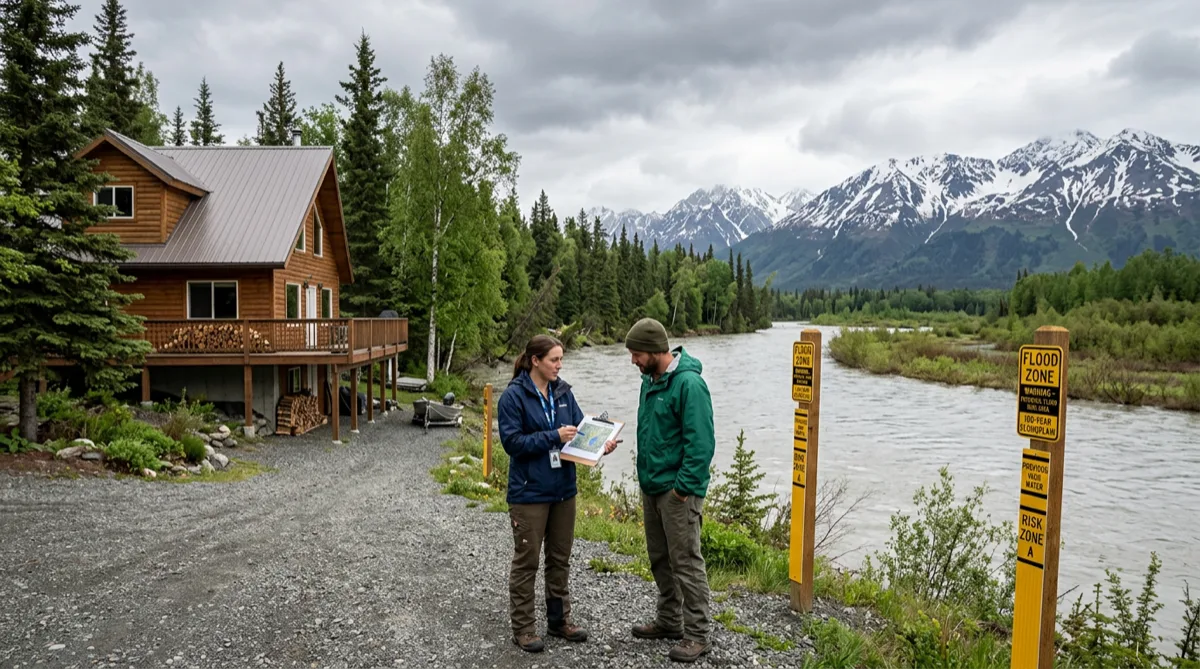
Most Alaska homebuyers don’t think of flooding as a significant risk — ice and snow are the obvious winter hazards. But Alaska has significant flood exposure, particularly from river flooding (ice jams causing rapid water rise) and coastal flooding in communities like Bethel, Shishmaref, Nome, and coastal Southcentral areas. If you’re buying a home in a designated Special Flood Hazard Area (SFHA), your lender will likely require flood insurance before closing.
This guide explains how flood insurance works in Alaska, when lenders require it, what it costs, and what options you have.
What Is a Special Flood Hazard Area?
FEMA’s National Flood Insurance Program (NFIP) maps flood risk through Flood Insurance Rate Maps (FIRMs). Properties in a “Special Flood Hazard Area” — also called a 100-year floodplain, or Zone A or Zone AE — have a 1% annual chance of flooding. Over a 30-year mortgage, a property in an SFHA has a roughly 26% chance of experiencing a flood event.
Federal law (the Flood Disaster Protection Act and Biggert-Waters Flood Insurance Reform Act) requires federally regulated lenders to mandate flood insurance on mortgaged properties in SFHAs. This applies to conventional loans, FHA, VA, and USDA loans. AHFC-backed mortgages also require flood insurance for properties in SFHAs.
If you’re buying a home in Anchorage, most residential neighborhoods are not in SFHAs — but waterfront properties along Ship Creek, Chester Creek, or Westchester Lagoon may be. Properties along the Matanuska and Susitna Rivers in the Mat-Su Valley carry ice jam flood risk that’s reflected in some FIRM maps.
How to Check If a Property Is in a Flood Zone
FEMA’s free online tool — the Flood Map Service Center at msc.fema.gov — lets you search any property address to check the flood zone designation. When you’re under contract on a home, your lender will pull this as part of the loan process and notify you if flood insurance is required.
Some caveats for Alaska:
- FEMA flood maps in rural Alaska are often unmapped (Zone D, which indicates undetermined risk) or outdated. An unmapped zone doesn’t mean no risk — it means FEMA hasn’t conducted a formal study.
- Ice jam flooding on Interior and Southcentral rivers creates risk patterns that aren’t fully captured in standard FIRM maps, which are designed for rainfall-driven flooding.
- Coastal erosion is a growing risk in western Alaska communities, with some communities facing existential flooding threats from permafrost thaw and sea level rise.
How Alaska’s Flood Insurance (NFIP) Works
The National Flood Insurance Program, administered by FEMA, is the primary source of flood insurance for residential properties. Most private insurers don’t offer flood insurance; NFIP is the standard option.
What NFIP covers:
- Building coverage: Up to $250,000 for the structure of a single-family home. Covers damage to the foundation, electrical and plumbing systems, HVAC, appliances, flooring, and walls.
- Contents coverage: Sold separately. Up to $100,000 for personal property within the home. Does NOT automatically come with building coverage — you must add it.
What NFIP does NOT cover:
- Temporary living expenses (no loss of use coverage — unlike homeowners insurance)
- Damage caused by moisture, mildew, or mold that could have been prevented
- Vehicles (separate auto insurance flood coverage needed)
- Basement-stored items (contents in basements have limited coverage)
What Flood Insurance Costs in Alaska
NFIP rates under the current Risk Rating 2.0 system are property-specific and based on factors including flood risk level, building characteristics, and coverage amounts. For most Alaska residential properties in SFHAs:
- Low-to-moderate risk zones: Premiums often range from $700–$1,500/year
- High-risk zones (AE, VE): Premiums can range from $1,500–$5,000+/year depending on the property’s specific risk
- Zone X (minimal risk): No federal requirement, but voluntary NFIP policies are available — often $300–$800/year
NFIP’s Risk Rating 2.0 (implemented in 2021) made rates more property-specific. Properties that were previously paying rates based on their location within the flood zone now pay based on their individual building’s risk profile — which means rates vary significantly even within the same zone.
An important Alaska note: Some Alaska properties are in SFHAs for ice jam risk, not rainfall flooding. NFIP policies cover flood from ice jams, but the risk model may not accurately reflect the actual ice jam probability for your specific river reach. Local knowledge from an insurance agent familiar with Alaska flood patterns is valuable here.
Adding Flood Insurance to Your Mortgage Budget
Flood insurance is escrowed by most lenders the same way property taxes and homeowners insurance are — paid monthly as part of your mortgage payment. Budget the annual premium divided by 12 as an additional line in your housing cost calculation.
On an $800,000 Anchorage home near a waterway, a $1,800/year flood insurance premium adds $150/month to your payment. That affects your debt-to-income calculation.
For buyers exploring what you can afford in Alaska, see Buying a House in Alaska for a full breakdown of homeownership costs including insurance.
Private Flood Insurance as an Alternative
Since 2019, Fannie Mae, Freddie Mac, and most government-backed loan programs accept private flood insurance as a substitute for NFIP, provided the private policy meets the statutory requirements. Private flood insurance sometimes offers:
- Higher coverage limits than NFIP’s $250,000 structural cap
- Coverage for loss of use (temporary living expenses while your home is being repaired)
- Replacement cost value rather than actual cash value
- Shorter waiting periods (NFIP has a 30-day waiting period after purchase; private policies may be shorter)
Ask your Alaska insurance agent about private flood insurance alternatives if NFIP premiums are high for your property.
Elevation Certificates and Rate Reduction
For properties in Zone AE, an elevation certificate — a document prepared by a licensed surveyor that measures the elevation of your lowest floor relative to the Base Flood Elevation — can reduce your NFIP premium if your home sits above the flood level. If the seller has an elevation certificate on file, ask for it. If not, it may be worth commissioning one after purchase if your intuition says the property is elevated above flood risk.
Ready to factor flood insurance into your Alaska home loan budget? Premier Mortgage (NMLS# 1168048) can help you understand the full cost picture before you make an offer.
Get a free home loan quote from Premier Mortgage (NMLS# 1168048)
Frequently Asked Questions
Does every Alaska home require flood insurance?
No. Flood insurance is federally required only on properties in designated Special Flood Hazard Areas (SFHAs) when financed with a federally regulated or insured mortgage. Homes outside designated flood zones don’t have a mandatory flood insurance requirement, though voluntary coverage is available and sometimes worth considering in rural or river-adjacent areas.
How do I find out if a property is in a flood zone?
Use FEMA’s Flood Map Service Center (msc.fema.gov) to search by address. Your mortgage lender will also conduct a flood zone determination as part of the loan process. Note that Alaska has many unmapped or outdated flood zone maps, particularly in rural areas — local lenders and insurance agents with Alaska experience can provide context that FEMA maps don’t.
What is the difference between building coverage and contents coverage in an NFIP policy?
NFIP building coverage (up to $250,000) covers the physical structure: foundation, walls, floors, electrical, HVAC, built-in appliances. Contents coverage (up to $100,000, sold separately) covers personal belongings inside the home. Buying only building coverage without contents coverage means your furniture, electronics, and personal property are not covered in a flood event.
How quickly can flood insurance be obtained before closing?
NFIP policies have a standard 30-day waiting period after purchase before coverage becomes effective (with some exceptions for loans). If a flood insurance requirement is discovered late in the loan process, this can delay closing. Request FEMA flood zone determination early in the homebuying process to avoid surprises.
Can VA or FHA loans waive the flood insurance requirement?
No. Federal law requires flood insurance on all federally backed mortgages (including FHA, VA, and USDA) on properties in SFHAs. This is a statutory requirement — individual lenders cannot waive it. The VA and FHA may have specific guidance on acceptable policy terms, but the requirement to have coverage cannot be waived.
Ready to Take the Next Step?
Get a free home loan quote today through our trusted partner.
Or call 9078411600
Disclaimer: This article is for informational purposes only and does not constitute financial, mortgage, legal, or tax advice. Interest rates, loan programs, eligibility requirements, and fees are subject to change without notice and may vary based on your individual circumstances. Alaska Home HQ is not a lender, broker, or financial institution. All loan applications are processed by Premier Mortgage (NMLS: 1168048). We may have a business relationship with Premier Mortgage and may receive compensation when you use their services through our links. Consult a licensed mortgage professional before making financial decisions. Terms of Service · Privacy Policy