Alaska Construction Loans: Build Your Dream Home
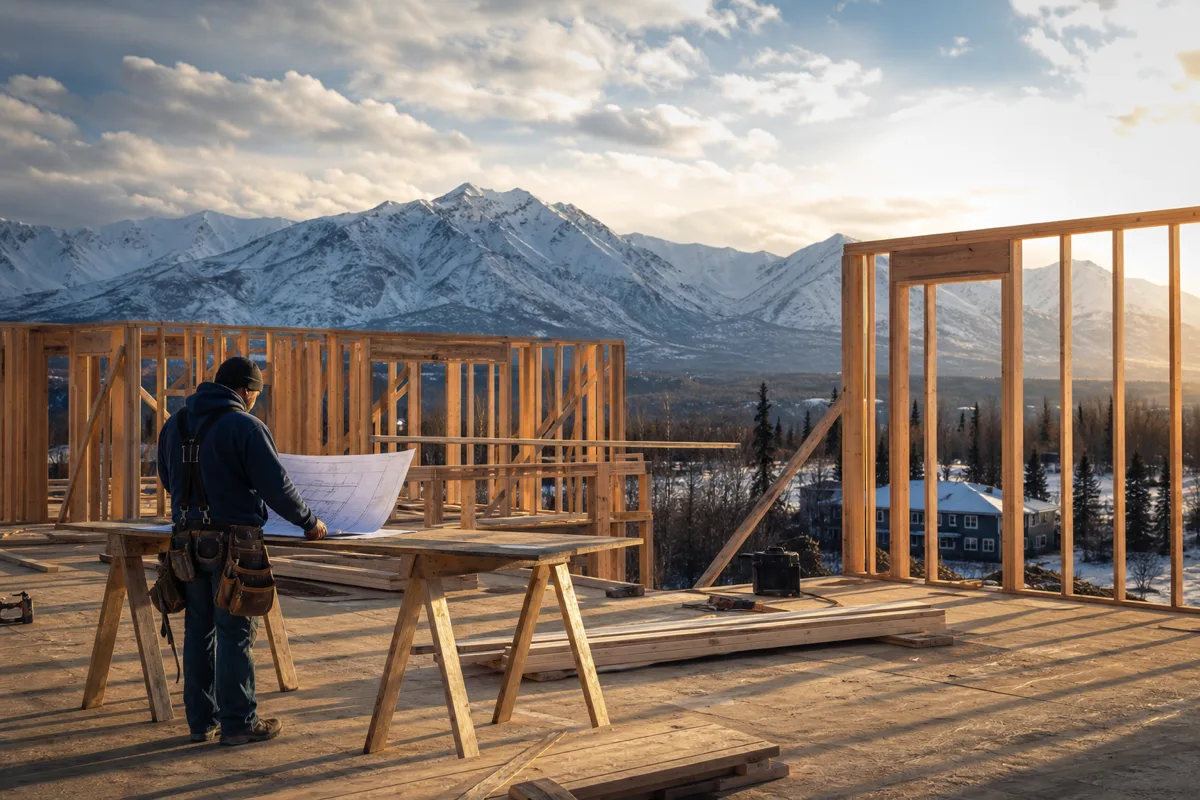
Alaska’s housing supply constraints — particularly in fast-growing areas like the Mat-Su Valley, greater Anchorage, and along the road system — push many buyers toward building rather than buying existing homes. A construction loan in Alaska finances the build itself, then converts into a permanent mortgage when the home is complete.
Understanding how this two-stage financing works is essential before breaking ground.
How Alaska Construction Loans Work
A construction loan is a short-term loan (typically 6-18 months) that funds the building of a new home. Unlike a standard mortgage, the money isn’t disbursed all at once — it’s released in draws as construction milestones are completed and inspected.
Typical draw schedule:
- Foundation complete
- Framing complete
- Rough mechanical, electrical, plumbing
- Insulation and drywall
- Interior finishing and final inspection
During construction, you typically pay interest only on the amount drawn, not the full loan. Once the home is complete and a certificate of occupancy is issued, the construction loan converts into (or is replaced by) a permanent mortgage.
Construction-to-Permanent vs. Two-Close Loans
There are two primary structures for Alaska construction financing:
Construction-to-Permanent (One-Close)
The most common approach. You close once, locking in the permanent mortgage rate at the beginning. During construction you make interest-only payments; at completion the loan converts automatically to a standard amortizing mortgage.
Advantage: One closing, one set of closing costs, rate locked at start.
Disadvantage: If the build takes longer than expected or interest rates drop, you’re locked in at your original rate.
Two-Close Construction Loan
You close on the construction loan at the start, then close again on the permanent mortgage at completion. More flexibility — you can shop for the best permanent mortgage rate after the home is built.
Advantage: Rate flexibility; more permanent loan options at completion.
Disadvantage: Two sets of closing costs, two underwriting processes, rate risk at second close.
For most Alaska buyers building in established areas, construction-to-permanent is simpler and usually more cost-effective.
Alaska Construction Loan Requirements
Construction lending is considered higher risk than standard mortgage lending, so requirements are stricter:
- Credit score: 680+ (most lenders); 720+ preferred
- Down payment: 20-25% of the total project cost is typical
- Debt-to-income ratio: 43% or lower
- Reserves: 6+ months of future housing payments in reserves after closing
- Detailed construction contract: Signed contract with licensed builder, detailed plans, and cost breakdown
- Licensed and insured builder: The general contractor must hold an Alaska contractor’s license and carry adequate liability and workers’ compensation insurance
Alaska-specific lenders often require a site inspection before approving the loan to assess access, utilities, and soil conditions — especially for Mat-Su Valley land that may have permafrost or drainage challenges.
Alaska Construction Loan Considerations
Short building season: Alaska’s road-accessible areas have a 5-6 month ideal construction window (May-October). Construction loans with 12-month terms may be tight. Negotiate an extension option upfront — many Alaska lenders build in a 6-month extension at a nominal fee.
Material costs and shipping: Building in Alaska costs 20-40% more than comparable Lower 48 construction due to shipping premiums on materials. Your appraiser will use Alaska-specific cost data, but ensure your construction budget is realistic before applying.
Permafrost considerations: If building on lots in Fairbanks or northern Alaska, permafrost engineering adds cost and time. Some lenders require geotechnical reports for sites in permafrost zones. See our permafrost foundation mortgage guide for details.
Rural and off-grid builds: Construction loans for off-grid properties (no municipal water, no road access, no utility connections) are significantly harder to finance through conventional lenders. AHFC has rural programs; some credit unions with Alaska expertise may lend on these sites. Financing off-grid builds typically requires substantially more equity (30-40% down).
VA Construction Loans in Alaska
Eligible veterans, active duty, and surviving spouses may qualify for a VA construction loan, which offers the same zero-down benefit for new construction as standard VA purchase loans.
VA construction loans are available but not offered by all lenders — you’ll need a VA-specialized lender familiar with the Alaska market. The VA requires the builder to be VA-registered and the plans to meet VA Minimum Property Requirements.
For Alaska military families at JBER, Eielson, or Clear SFS considering building in the Mat-Su Valley or greater Anchorage, a VA construction-to-permanent loan can be an excellent option. Our VA loans Alaska guide covers eligibility and entitlement in detail.
AHFC Financing for New Construction
Alaska Housing Finance Corporation (AHFC) programs — including First Home and Veterans Mortgage — can be used for new construction in some cases. AHFC’s interest rate reductions for energy-efficient construction are particularly valuable: new builds meeting AHFC Tier 5 energy standards may qualify for a 1.5% rate reduction.
See our AHFC loan programs guide for current program availability and rates.
Steps to Get an Alaska Construction Loan
- Secure your land — many lenders require you to own the lot free and clear (or with a small mortgage) before approving a construction loan
- Select a licensed Alaska builder — lenders require a licensed contractor with verifiable track record
- Develop detailed plans and specifications — the lender orders an appraisal based on completed plans (“as-complete” value)
- Apply for the construction loan — full underwriting including income, credit, and project documentation
- Close the construction loan — you’ll need your down payment at closing
- Fund draws as construction progresses — each draw requires an inspection confirming milestone completion
- Complete the home and close permanent financing — final inspection, certificate of occupancy, conversion to mortgage
For more on the broader homebuying and building process in Alaska, see our Alaska home buying process guide.
Ready to explore construction financing for your Alaska build? Get a free consultation from Premier Mortgage (NMLS# 1168048).
Frequently Asked Questions
How much down payment do I need for an Alaska construction loan?
Most Alaska lenders require 20-25% down on construction loans, reflecting the higher risk of lending on a property that doesn’t yet exist. Some VA construction loans allow zero down for eligible veterans. The down payment is calculated on the total project cost — land plus construction — not just the building cost.
Can I be my own general contractor for an Alaska construction loan?
Some lenders allow “owner-builder” construction loans where the homeowner manages the build. These are harder to qualify for and typically require documented construction experience. For most Alaska buyers, using a licensed general contractor is the path of least resistance for financing approval.
How long does an Alaska construction loan last?
Most Alaska construction loans have 12-month terms with optional 6-month extensions. Alaska’s short building season means timelines can slip — negotiate for an extension option before closing. Extension fees are typically 0.25-0.5% of the loan amount per extension period.
What happens if the construction goes over budget?
Construction loan overruns must be funded by the borrower — lenders don’t extend the approved loan amount for cost overruns. This is why building a 10-15% contingency into your budget is essential, especially in Alaska where material and labor costs can shift significantly. If you run out of construction funds, you may need to bring cash to close the permanent mortgage.
Can I use an FHA loan for new construction in Alaska?
Yes. FHA offers a construction-to-permanent product (FHA OTC — One-Time Close) that allows qualified buyers to build with as little as 3.5% down. FHA new construction requires the builder to be FHA-approved and the plans to meet FHA Minimum Property Requirements. Ask your lender whether they offer the FHA OTC product, as not all lenders administer it.
Ready to Take the Next Step?
Get a free home loan quote today through our trusted partner.
Or call 9078411600
Disclaimer: This article is for informational purposes only and does not constitute financial, mortgage, legal, or tax advice. Interest rates, loan programs, eligibility requirements, and fees are subject to change without notice and may vary based on your individual circumstances. Alaska Home HQ is not a lender, broker, or financial institution. All loan applications are processed by Premier Mortgage (NMLS: 1168048). We may have a business relationship with Premier Mortgage and may receive compensation when you use their services through our links. Consult a licensed mortgage professional before making financial decisions. Terms of Service · Privacy Policy