Alaska Holding Tank Septic Mortgage
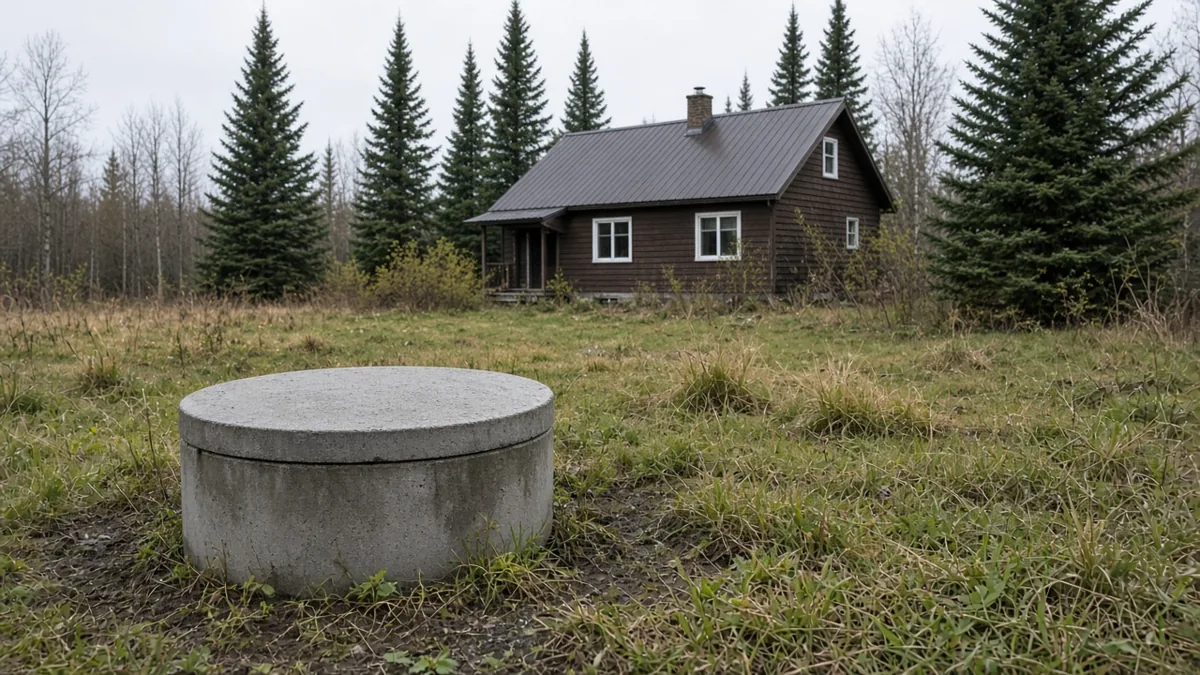
An Alaska holding tank septic mortgage file is a wastewater question wearing a loan file’s clothes. A holding tank stores wastewater until a truck pumps it and hauls it away. A conventional septic system uses a septic tank and then a soil absorption system, which is the drain field. Lenders that follow agency property standards often want an approved wastewater system that the local health authority will stand behind. A tank that only stores sewage can be that system when the approval paper says so. A lid in the yard, with no paper, is a lid.
The well and septic requirements page is the general private-system file. The inspection guide is how an inspector writes up what is in the ground today. The DEC approval guide is which approval path the paper belongs to. The cesspool and seepage-pit guide is a different pit, with a different rule. Buyers looking at dry lots out of Fairbanks should keep those pages apart. A hauled-water house is a separate water article. Water delivery and wastewater disposal are two inspections.
Alaska Home HQ is educational. It is not a lender and it is not the Department of Environmental Conservation. Rates vary. Subject to credit approval.
What an Alaska holding tank septic mortgage is describing
The wastewater chapter defines a holding tank as a watertight vessel or tank for the temporary storage of wastewater, urine, or excrement. The definition includes a vault privy. It does not include a pit privy. That definition is in 18 AAC 72.990, in the chapter text DEC posted. The same chapter defines a conventional wastewater system as a system that, with or without pumps and lift stations, uses a septic tank followed by disposal into a conventional soil absorption system. A holding tank does not do that second step. Nothing leaches out through a field. The tank fills. Someone pumps it.
The old section numbered 18 AAC 72.025, titled “Holding tanks,” was repealed effective October 1, 2023. The editor’s note says holding tanks are addressed under 18 AAC 72.601 through 18 AAC 72.660 as alternative wastewater systems. A pamphlet that still cites the repealed section is stale. The alternative-system article is where the current text puts the tank.
18 AAC 72.615(d) says that when plans are submitted for an alternative system that proposes a holding tank, other than marine sanitation devices or tanks wholly contained inside a mobile food unit or occupied building, the plans must include several items. They must justify the holding tank as the most practicable and feasible wastewater system for the facility and the site. They must include calculations for the tank size and the design flow, providing a minimum of two days’ storage capacity, or more if the department says more is necessary. They must specify a visual beacon and an audio high-water alarm that tells the users when pumping is required, with drawings of the alarm levels and the manufacturer’s cut sheet. They must provide for resisting buoyancy when the tank is pumped. They must describe access for pumping, whether a pumper and hauler are available, and where the waste will finally be disposed.
Those are plan contents for the submittal the section describes. They are not a promise that every existing cabin tank was built to that list. An older tank can still be in the ground. The loan file then asks what approval, registration, or engineer’s record exists for the tank that is actually there. The approval guide is the page for that paper chase.
Separation distances, stated the way the chapter states them
18 AAC 72.100(a) says that unless the department has approved a lesser minimum separation distance, a person who installs, modifies, or operates a source of drinking water for a private water system must keep stated distances from potential sources of contamination. Paragraph (a)(1) requires at least 100 horizontal feet, measured nearest edge to nearest edge, to a list that includes a septic tank, a wastewater holding tank, and a soil absorption system, among other things. The wastewater holding tank is named on that list as its own item. The 100-foot figure in that paragraph applies to it because the text names it. The same paragraph also names the septic tank and the soil absorption system. A holding tank is still not a soil absorption system. The chapter lists them separately.
That 100-foot measurement is from the drinking-water source. It is not a sentence about a water-storage cistern. Subsection (b) of the same section is the one that talks about a water holding tank and a private water line, and it uses different distances. Do not paste the well’s 100-foot list onto a cistern, and do not paste the cistern’s shorter list onto the well.
A different 100-foot sentence sits in 18 AAC 72.620(b), for alternative wastewater systems. It sets 100 feet between certain surface waters and a septic tank, a primary treatment tank, a treatment unit, a package plant, a soil absorption system, and a land surface disposal area. That sentence does not name a holding tank. This article does not apply that surface-water figure to a holding tank. The drinking-water separation in 72.100(a)(1) is the sentence that names the wastewater holding tank.
The department can approve a lesser distance. The editor’s note to 18 AAC 72.100 points readers to 18 AAC 72.060, 18 AAC 72.540, 18 AAC 72.640, or an approval under 18 AAC 72.200 through 18 AAC 72.290. A waiver is a piece of paper. A seller’s memory that “DEC said it was fine” is not the waiver.
What lenders are usually trying to see
Agency handbooks often want a property to have a working wastewater system that meets the local health authority, or a connection to a public system when that connection is feasible. FHA’s current handbook language is discussed on the cesspool page, and it is a federal mortgage standard. It is not a reprint of 18 AAC 72. This page does not say the department and FHA use the same distances. Alaska’s distances are the ones in the chapter you just read. A lender can also ask for the pump receipts, the alarm test, and a contract or a letter showing a hauler will take the waste.
An appraiser who writes “septic” because there is a lid may be describing the wrong system. Ask the inspector to say “holding tank” if that is what they opened. The inspection guide is where those words get matched to the loan file.
18 AAC 72.611 lets some alternative systems be installed or modified without prior approval when the on-lot flow is 1,500 gallons per day or less, or when the system is holding tanks only for a temporary mining or oil-and-gas camp, and the separation, construction, and registered-engineer conditions in that section are met. A system outside those limits needs prior approval under 18 AAC 72.611(b). A house tank is not automatically on the no-approval path.
For design flow on an alternative system, 18 AAC 72.630(b) says to use 150 gallons per day for each bedroom in a residential dwelling. That figure sizes the system in the chapter. It does not predict the pump bill. The lender may still want proof a hauler serves that road in winter.
How to build the file
Ask the seller for the DEC approval, the registration, the engineer’s record documents, or the after-the-fact paperwork if that is what exists. Ask for a year of pump receipts if they have them. Ask where the waste is taken. A tank with no disposal path is a tank that will overflow. 18 AAC 72.090 treats a wastewater system as in failure in the circumstances that section lists, including a system that stops working as designed or as approved. Surfacing sewage is a failure problem and a loan problem.
If the lot can support a soil absorption system and the buyer wants one, that is a construction question and a replacement-financing question. It is not required by this page. Some lots use a holding tank because soils, permafrost, a high water table, or a small lot will not take a field. The plan section’s demand for a justification is aimed at that site-specific story. Put the justification in the loan file when you have it, so the underwriter is not left guessing why there is no drain field.
The chapter is statewide. A buyer on the road system out of Homer should still call the hauler before waiving an inspection, and keep the wastewater paper separate from the well test.
Ready to explore your options? Get a free home loan quote from Premier Mortgage (NMLS# 1168048).
Frequently Asked Questions
Is a holding tank the same thing as a septic system?
The chapter defines a conventional wastewater system as a septic tank followed by a conventional soil absorption system. A holding tank is defined as watertight temporary storage of wastewater, urine, or excrement, and the definition includes a vault privy. The tank is pumped. It does not discharge to a drain field.
Does the 100-foot well separation apply to a wastewater holding tank?
18 AAC 72.100(a)(1) lists a wastewater holding tank among the items that must be at least 100 horizontal feet from a private drinking-water source, unless the department has approved a lesser distance. The same paragraph also lists the septic tank and the soil absorption system. The surface-water sentence in 18 AAC 72.620(b) does not name a holding tank, so this page does not apply that sentence to one.
Can a house use a holding tank without prior DEC approval?
18 AAC 72.611 allows some alternative systems to be installed or modified without prior approval when the flow, separation, construction, and registered-engineer conditions in that section are met. A system outside those conditions needs prior approval. Holding tanks only, for a temporary mining or oil-and-gas camp, are a separate branch of the same section. Ask which branch, if any, the paper for this house used.
What should the mortgage file contain?
Ask for the approval or registration, the engineer’s documents, pump receipts, alarm information, and the hauler and disposal location. 18 AAC 72.615(d) shows the plan items the department asks for when a holding tank is proposed under that section, including at least two days of storage on those plans. Match the loan condition to the system in the ground.
Will every lender finance a holding tank?
Many agency files want a wastewater system the local authority accepts and that is working. A holding tank with approval paper and a real pump-out plan may clear. A tank with no paper, no alarm, and no hauler may not. Ask the lender which standard the loan uses, and keep DEC’s chapter separate from any federal property handbook.
Ready to Take the Next Step?
Get a free home loan quote today through our trusted partner.
Or call 9078411600
Disclaimer: This article is for informational purposes only and does not constitute financial, mortgage, legal, or tax advice. Interest rates, loan programs, eligibility requirements, and fees are subject to change without notice and may vary based on your individual circumstances. Alaska Home HQ is not a lender, broker, or financial institution. All loan applications are processed by Premier Mortgage (NMLS: 1168048). We may have a business relationship with Premier Mortgage and may receive compensation when you use their services through our links. Consult a licensed mortgage professional before making financial decisions. Terms of Service · Privacy Policy