Foundations & Permafrost in Alaska Homes
Foundations and Permafrost in Alaska Homes: What Homeowners and Buyers Need to Know
Your home’s foundation does one job — keep the structure stable, level, and secure on the ground beneath it. In most of the country, that’s a relatively straightforward engineering problem. In Alaska, foundations and permafrost create a relationship that demands careful design, informed construction, and ongoing attention.
Whether you’re buying an existing home, building new, or noticing cracks and settling in your current house, understanding how Alaska’s unique ground conditions affect your foundation is essential knowledge. This guide covers the foundation types common across the state, the specific challenges of permafrost and frost heave, and what to look for during a home inspection.
Foundation Types Used in Alaska Homes
Alaska builders select foundation types based on soil conditions, permafrost presence, local building codes, and budget. Here are the most common approaches:
Driven Pile Foundations
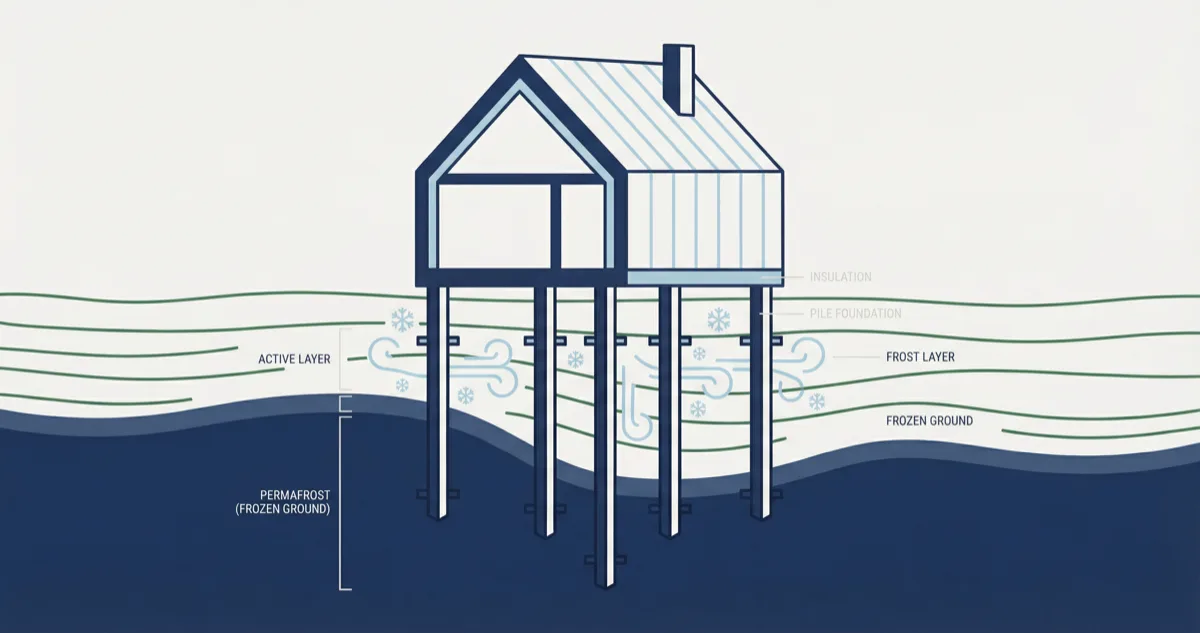
Pile foundations are the standard approach in permafrost areas, particularly around Fairbanks and interior Alaska. Steel or timber piles are driven deep into the ground — often 15 to 30 feet or more — to reach stable soil or permanently frozen ground below the active layer.
The home is then elevated on the piles, creating an air gap between the floor and the ground surface. This air gap serves a critical purpose: it allows cold air to circulate beneath the home, keeping the underlying permafrost frozen and stable.
Advantages:
- Most reliable foundation type in permafrost zones
- Adjustable — piles can sometimes be shimmed or releveled if minor settling occurs
- Proven track record in Fairbanks and Interior communities
Considerations:
- Higher initial cost than slab-on-grade
- Elevated homes require insulated floors and protected plumbing
- The space beneath the home needs maintenance and monitoring
Slab-on-Grade Foundations
A concrete slab poured directly on prepared ground is common in areas without permafrost — much of Anchorage, the Mat-Su Valley, the Kenai Peninsula, and Southeast Alaska. The slab sits on a gravel pad with rigid foam insulation beneath and around the perimeter to manage frost penetration.
Advantages:
- Cost-effective construction
- No crawlspace to maintain
- Works well in permafrost-free areas with well-drained soils
Considerations:
- Not appropriate in permafrost zones — the heat from the building can thaw underlying frozen ground
- Repairs to plumbing under the slab are expensive and disruptive
- Frost heave can crack slabs if insulation and drainage are inadequate
Crawlspace Foundations
Crawlspace foundations elevate the home on a perimeter wall (concrete, block, or treated wood) with a vented or conditioned space beneath the floor. They’re common throughout Southcentral Alaska and some parts of Southeast.
Advantages:
- Accessible space for plumbing, electrical, and HVAC components
- Provides a buffer between the living space and the ground
- Can be insulated and conditioned to improve energy efficiency
Considerations:
- Moisture management is critical — ventilation, vapor barriers, and drainage must be properly designed
- In cold climates, frozen pipes in crawlspaces are a real risk without adequate insulation and heat
- Not a preferred option in permafrost areas
Full Basements
Full basements are less common in Alaska than in the Lower 48, primarily due to cost and ground conditions. Excavating through rocky, frozen, or permafrost-affected soil is expensive, and moisture management in Alaska’s climate adds complexity. That said, some homes — particularly in Anchorage and well-drained areas — do have basements that provide valuable additional living and storage space.
Understanding Permafrost: Why It Matters for Your Foundation
Permafrost is ground that remains frozen (at or below 32F) for two or more consecutive years. In Alaska, permafrost conditions vary dramatically by region:
- Continuous permafrost — Found in northern Alaska (North Slope, parts of the Brooks Range). Ground is frozen everywhere except under rivers and deep lakes.
- Discontinuous permafrost — Common in Interior Alaska, including the Fairbanks area. Permafrost exists in patches — some lots have it, neighboring lots may not. South-facing slopes and well-drained areas are less likely to have permafrost.
- No permafrost — Most of Southcentral Alaska (Anchorage, Mat-Su Valley, Kenai Peninsula) and Southeast Alaska have no permafrost, though seasonal frost penetration still affects foundation design.
The Active Layer
The active layer is the top layer of soil that thaws each summer and refreezes each winter. In Fairbanks, the active layer typically extends 2 to 6 feet below the surface, depending on soil type, vegetation, and sun exposure. Foundation design must account for this seasonal freeze-thaw cycle.
Why Permafrost and Buildings Don’t Mix Well
Here’s the fundamental problem: buildings generate heat. Heat radiates downward through foundations into the ground. In permafrost areas, that heat can thaw the frozen soil beneath the building, causing:
- Thaw settlement — As ice-rich permafrost melts, the ground loses volume and compresses unevenly. This causes differential settlement — one part of the foundation sinks more than another, leading to cracked walls, stuck doors, broken utility connections, and structural damage.
- Progressive degradation — Once thawing begins, it tends to accelerate. The disturbed ground insulates differently, moisture moves into new patterns, and the damage compounds over time.
This is why pile foundations with ventilated air gaps are the standard in permafrost zones — they keep the building’s heat separated from the frozen ground.
Frost Heave: Alaska’s Other Foundation Challenge
Even in areas without permafrost, frost heave affects foundations across most of Alaska. Frost heave occurs when water in the soil freezes and expands, pushing the ground (and anything sitting on it) upward. When the ground thaws, it settles back — but not always evenly.
What Causes Frost Heave
Three conditions must be present simultaneously:
- Freezing temperatures reaching the soil beneath the foundation
- Frost-susceptible soil — Fine-grained soils like silt and clay are most vulnerable. Well-drained gravel and sand resist frost heave.
- Available moisture — Water wicking up from the water table or poor drainage feeds ice lens formation
Preventing Frost Heave
Proper foundation design in Alaska addresses all three factors:
- Insulation — Rigid foam insulation beneath and around foundation perimeters reduces frost penetration depth. Building codes in Alaska specify minimum insulation requirements for foundations.
- Drainage — Gravel pads, French drains, and proper grading direct water away from the foundation.
- Non-frost-susceptible fill — Replacing native soil with engineered gravel beneath the foundation eliminates the frost-susceptible material.
- Frost depth considerations — Foundation footings are typically placed below the maximum frost penetration depth for the area — 5 to 8 feet in parts of Interior Alaska.
Foundation Problems: Warning Signs to Watch For
Whether you’re a current homeowner or a prospective buyer, these signs may indicate foundation issues:
Exterior Signs
- Cracks in the foundation wall, especially diagonal or stair-step cracks in block or concrete
- Gaps between the foundation and the siding or trim
- Uneven settling visible in the foundation line — one corner or section lower than the rest
- Leaning or bowing foundation walls
- Water pooling near the foundation or evidence of past flooding
Interior Signs
- Doors and windows that stick, don’t close properly, or have uneven gaps
- Cracks in drywall, especially around door and window frames
- Sloping or uneven floors — check with a level or a marble
- Gaps between walls and ceilings or floors
- Cracked tile or buckling flooring
In Permafrost Areas Specifically
- Progressive leaning or tilting of the structure
- Growing gaps between the building and attached decks, porches, or garages
- Utility connections (water, sewer, gas) showing stress or separation
- Changes in the air gap beneath pile-supported buildings — if the gap is closing on one side, the piles on that side are settling
Not every crack indicates a serious problem — some hairline cracking is normal as concrete cures and buildings settle initially. But in Alaska, especially in permafrost zones, new or worsening cracks deserve professional evaluation.
Foundation Inspections: What Buyers Should Know
If you’re buying a home in Alaska, the foundation inspection is arguably the most important part of the home inspection process. Here’s what to expect and what to ask:
Hire the Right Inspector
In permafrost areas, look for an inspector or structural engineer with specific experience in Alaska foundation systems. General home inspectors may not have the expertise to evaluate pile foundations, identify permafrost-related settlement, or distinguish between normal settling and progressive failure.
What a Good Inspection Covers
- Visual examination of all accessible foundation components
- Level measurements across the structure to identify differential settlement
- Assessment of drainage and grading around the foundation
- Review of any previous repair or releveling history
- In pile-supported homes, inspection of pile connections, air gap clearance, and signs of thermal disturbance
- Evaluation of insulation and vapor barriers in crawlspaces
Questions to Ask the Seller
- Has the home ever been releveled or had foundation repairs?
- Are there any known permafrost conditions on the property?
- Has vegetation or grading been changed near the foundation?
- What is the history of water intrusion or drainage issues?
Foundation Repair Costs in Alaska
Foundation repairs in Alaska vary widely depending on the problem and the solution:
| Repair Type | Typical Cost Range |
|---|---|
| Minor crack sealing | $500–$2,000 |
| Crawlspace moisture management | $2,000–$8,000 |
| Releveling a pile-supported home | $5,000–$20,000 |
| Pier or pile reinforcement | $10,000–$30,000 |
| Major structural repair or replacement | $25,000–$75,000+ |
| Complete foundation replacement | $50,000–$150,000+ |
Early intervention almost always costs less than waiting for problems to worsen. A $5,000 drainage improvement now may prevent a $50,000 structural repair later.
Building New: Foundation Best Practices for Alaska
If you’re building a new home in Alaska, these foundation principles apply regardless of location:
- Get a geotechnical report — A soil investigation before design begins identifies permafrost, soil type, water table depth, and bearing capacity. This is not optional — it’s the basis for sound foundation engineering.
- Design for the site, not the budget — Cutting corners on foundation design is the most expensive mistake you can make in Alaska construction. A properly engineered foundation costs more upfront but prevents catastrophic failures later.
- Maintain the thermal regime — If building on permafrost, the foundation design must keep the ground frozen. This means adequate air gaps, thermosyphons (passive cooling devices), insulation, and careful site management.
- Plan for drainage — Grade the site to direct surface water and snowmelt away from the foundation. Install drainage systems if the water table is high.
- Protect the building envelope — Insulate foundation components to current energy code standards. In Alaska, foundation insulation does double duty — it saves energy and protects against frost heave.
For complementary guidance on keeping your home protected through Alaska’s winters, see our winterizing your Alaska home checklist and our home insulation guide for Alaska.
Need to finance foundation repairs or permafrost mitigation work? A HELOC or home equity loan from Premier Mortgage can cover major structural repairs using your home equity. Premier Mortgage | NMLS# 1168048 | Equal Housing Lender
Frequently Asked Questions
How do I know if my Alaska property has permafrost?
In the Fairbanks area and Interior Alaska, permafrost presence varies from lot to lot. A geotechnical investigation (soil boring) is the definitive way to determine whether permafrost exists on your property and at what depth. Visual clues include “drunken forest” (leaning trees caused by shifting ground), thermokarst depressions (sunken areas from thawed ice), and tussock-covered terrain. Your borough planning office or the Alaska Division of Geological and Geophysical Surveys may have regional permafrost maps, but site-specific testing is always recommended before building.
Can a home on permafrost be safe to buy?
Yes, absolutely — thousands of homes in Fairbanks and across Interior Alaska sit on permafrost and perform well for decades. The key is that the foundation was properly designed for permafrost conditions (typically pile foundations with ventilated air gaps) and that the thermal regime hasn’t been disturbed. During your inspection, look for evidence of progressive settling, damaged utility connections, or modifications that may have altered the building’s relationship with the frozen ground. A structural engineer familiar with Fairbanks permafrost conditions can provide a reliable assessment.
What causes frost heave, and can it be fixed?
Frost heave occurs when water in frost-susceptible soil freezes and expands, lifting the ground and anything on it. It requires three simultaneous conditions: freezing temperatures reaching the soil, fine-grained soil (silt or clay), and available moisture. Fixing frost heave damage typically involves addressing the root cause — improving drainage to reduce moisture, adding insulation to limit frost penetration, or replacing frost-susceptible soil with gravel. In severe cases, structural repairs to the foundation may also be needed. Prevention through proper design is always more cost-effective than remediation.
How deep do foundations need to be in Alaska?
Foundation depth depends on location and soil conditions. Building codes typically require footings to extend below the maximum frost penetration depth for the area. In Anchorage, that’s generally 4 to 5 feet. In Fairbanks and Interior Alaska, frost depth can reach 6 to 8 feet or more. Pile foundations in permafrost areas extend much deeper — often 15 to 30 feet — to reach stable bearing in permanently frozen ground. Your geotechnical report and structural engineer will specify the appropriate depth for your specific site.
Should I worry about climate change affecting my foundation?
In permafrost regions, warming temperatures are a legitimate long-term concern. Rising average temperatures can deepen the active layer and degrade permafrost, potentially affecting foundations that were designed for colder conditions. Fairbanks and other Interior communities are actively studying and adapting to these changes. If you’re buying or building in a permafrost area, discuss climate resilience with your engineer and consider conservative design approaches. Monitoring your foundation for any signs of new or accelerating settlement is good practice regardless.
Finance Your Home Improvement Project
A HELOC or home equity loan from Premier Mortgage lets you tap your home's value to fund renovations, repairs, and upgrades at competitive rates.
Or call 9078411600
Disclaimer: This article is for informational purposes only and does not constitute financial, mortgage, legal, or tax advice. Interest rates, loan programs, eligibility requirements, and fees are subject to change without notice and may vary based on your individual circumstances. Alaska Home HQ is not a lender, broker, or financial institution. All loan applications are processed by Premier Mortgage (NMLS: 1168048). We may have a business relationship with Premier Mortgage and may receive compensation when you use their services through our links. Consult a licensed mortgage professional before making financial decisions. Terms of Service · Privacy Policy